Ten minutes to explain months.Give your doctor something to work with.
Symptoms shift, triggers differ, and no two days look alike, which is impossible to describe from memory. Log heart rate, symptoms, triggers, fluids and salt in seconds. Steady On runs 16 analyses over what you log: time of day, heat, sleep, your cycle, medication, blood pressure. It turns months of that into one page your doctor can actually use. A 12-week reconditioning programme comes with it. Worth your salt.
Free forever: the rescue page, the whole Learn library, symptom and heart-rate logging, guided lean tests and week one of the programme. No card, no trial clock.
It is one app, and people arrive at it for four quite different
reasons. Any of them is a good enough reason to start, and three of the four cost
nothing.
Feeling awful this minute? The rescue toolkit is counter-manoeuvres that work in thirty seconds. Free forever, no account needed, and it keeps working with no signal.
Open the rescue page →
See it before you buy
The report your doctor actually gets
Most appointments for this last ten minutes, and most of them are spent trying to
describe a year from memory. This is one page you can print or email ahead: your own
measurements, laid out for a clinician, drawing no conclusions.
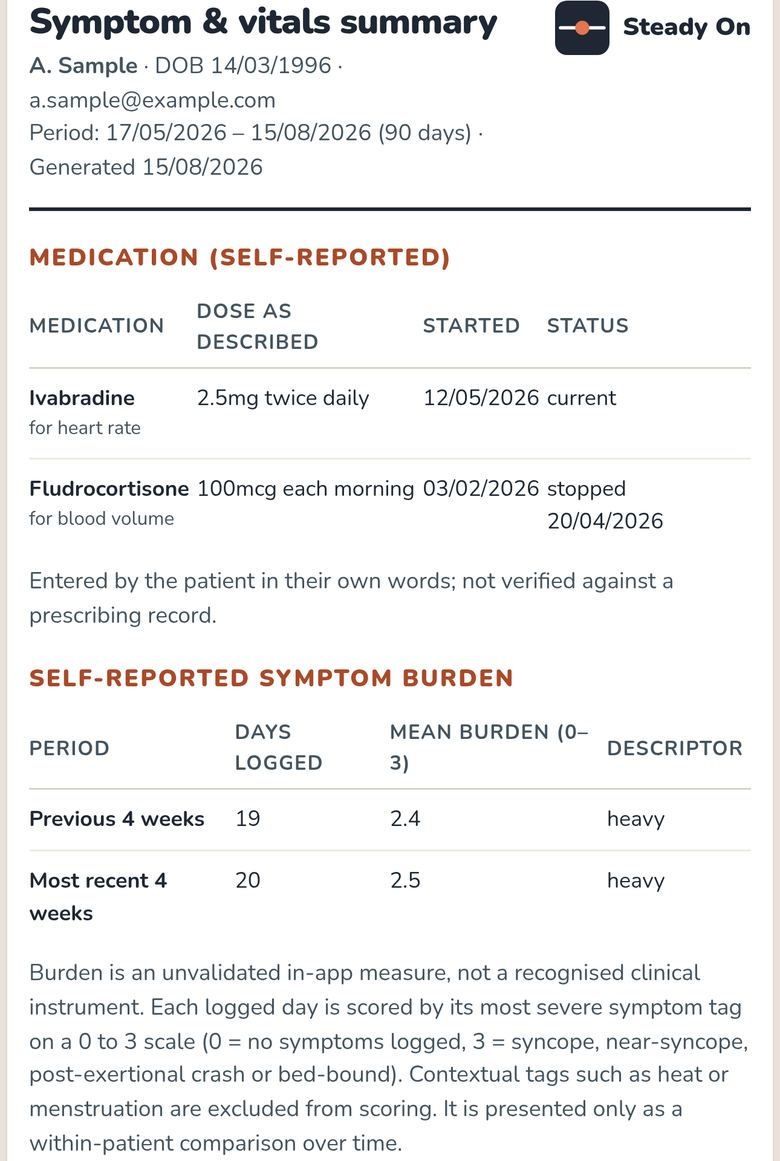
EXAMPLE REPORTFictional patient. Generated by the live app from invented data, not a real person's records.
Entered by the patient in their own words; not verified against a prescribing record.
Self-reported symptom burden
Period
Days logged
Mean burden (0–3)
Descriptor
Previous 4 weeks
19
2.4
heavy
Most recent 4 weeks
20
2.5
heavy
Burden is an unvalidated in-app measure, not a recognised clinical instrument. Each logged day is scored by its most severe symptom tag on a 0 to 3 scale (0 = no symptoms logged, 3 = syncope, near-syncope, post-exertional crash or bed-bound). Contextual tags such as heat or menstruation are excluded from scoring. It is presented only as a within-patient comparison over time.
Graduated exercise programme
Started
01/07/2026
Current week
7 of 12
Sessions completed
29
Weeks repeated
0
Burden, month before start vs since
2.2 → 2.5
Mean standing HR, before vs now
101 → 102 bpm
Lean test ΔHR, before vs now
41 → 34 bpm
Self-directed graduated exercise, content adapted from published recumbent-to-upright protocols. Not clinician-prescribed. The patient confirmed at enrolment that their doctor was aware they were starting.
Heart rate by position
Position
Readings
Average
Range
Lying
73
66 bpm
62–70 bpm
Sitting
19
82 bpm
77–87 bpm
Standing
126
101 bpm
85–118 bpm
Change on standing (same-day paired readings)
Days with both positions
Mean increase
Range
73
+36 bpm
+24 to +48 bpm
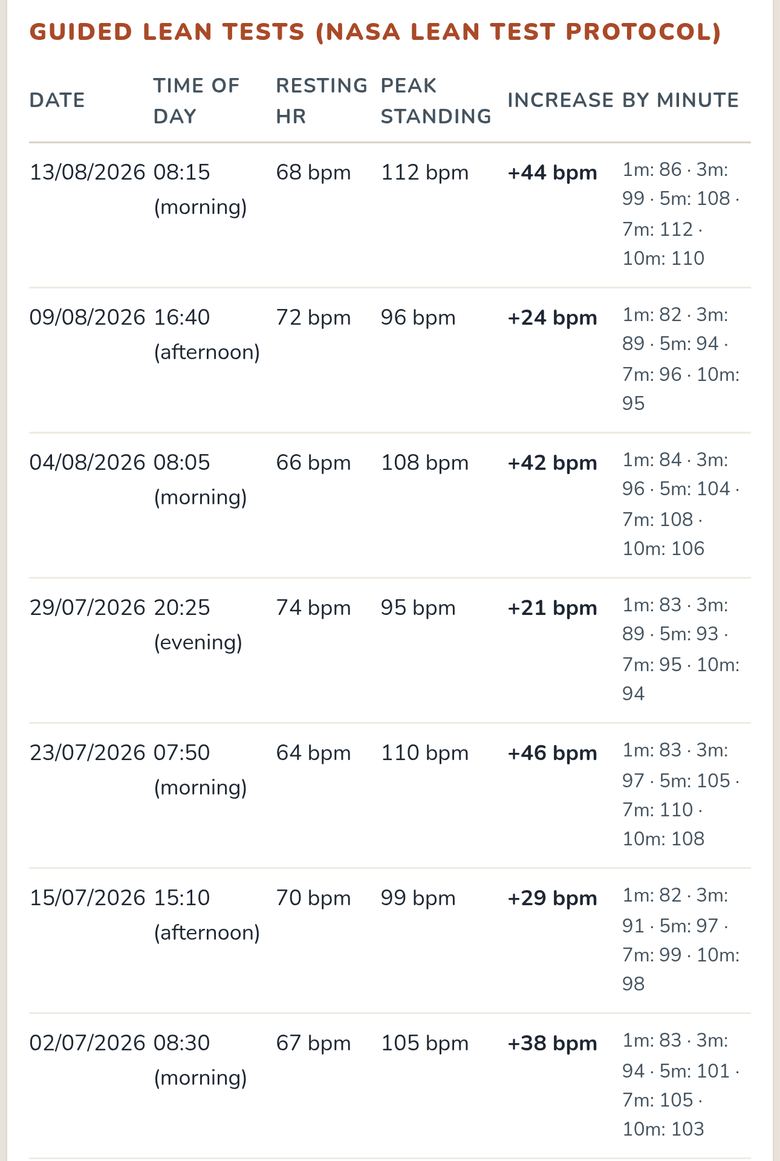
Guided lean tests (NASA Lean Test protocol)
Date
Time of day
Resting HR
Peak standing
Increase
By minute
13/08/2026
08:15 (morning)
68 bpm
112 bpm
+44 bpm
1m: 86 · 3m: 99 · 5m: 108 · 7m: 112 · 10m: 110
09/08/2026
16:40 (afternoon)
72 bpm
96 bpm
+24 bpm
1m: 82 · 3m: 89 · 5m: 94 · 7m: 96 · 10m: 95
04/08/2026
08:05 (morning)
66 bpm
108 bpm
+42 bpm
1m: 84 · 3m: 96 · 5m: 104 · 7m: 108 · 10m: 106
29/07/2026
20:25 (evening)
74 bpm
95 bpm
+21 bpm
1m: 83 · 3m: 89 · 5m: 93 · 7m: 95 · 10m: 94
23/07/2026
07:50 (morning)
64 bpm
110 bpm
+46 bpm
1m: 83 · 3m: 97 · 5m: 105 · 7m: 110 · 10m: 108
15/07/2026
15:10 (afternoon)
70 bpm
99 bpm
+29 bpm
1m: 82 · 3m: 91 · 5m: 97 · 7m: 99 · 10m: 98
02/07/2026
08:30 (morning)
67 bpm
105 bpm
+38 bpm
1m: 83 · 3m: 94 · 5m: 101 · 7m: 105 · 10m: 103
18/06/2026
09:00 (morning)
69 bpm
110 bpm
+41 bpm
1m: 86 · 3m: 98 · 5m: 106 · 7m: 110 · 10m: 108
Time of day. Orthostatic heart rate increment shows marked diurnal variability, being largest in the morning. In 54 patients at an adult autonomic centre, standing heart rate was significantly higher in the morning (102 ± 3 bpm) than in the evening (93 ± 2 bpm), with greater orthostatic tachycardia in the morning (Brewster et al., Clin Sci 2012;122:25–31). In 113 patients given the orthostatic vital sign test twice, once in the afternoon and again the following morning, 82.6% of those with POTS met the criteria on the morning test against 52.2% in the afternoon, and 65.2% returned a normal result on a single test; the authors recommended repeat testing in clinically suspected cases (Moon et al., J Am Soc Hypertens 2016;10:e1). The effect is larger again in children (Cai et al., Front Pediatr 2021: 43 patients aged 9–14, 100% morning, 44% afternoon, 28% evening). Times are given above so results taken later in the day can be interpreted accordingly.
Notes: 29/07/2026: Very hot day, and slept badly the night before.
Blood pressure by position
Position
Readings
Mean
Systolic range
lying
73
106/67 mmHg
101–111
sitting
19
106/70 mmHg
103–110
standing
126
104/73 mmHg
96–112
Mean same-day change on standing across 73 days: -2 / +6 mmHg
Most-recorded symptoms & context
severe fatigue
27 times
dizzy
17 times
palpitations
12 times
brain fog
8 times
coat-hanger pain
5 times
nausea
4 times
breathless
4 times
Average daily intake (self-logged)
Fluids: 2212 ml/day · Added salt: 6.8 g/day (across 81 days with entries)
These are self-recorded measurements taken by the patient at home using their own equipment, summarised by Steady On. Steady On is an educational self-tracking tool, not a medical device, and provides no diagnosis or interpretation. Individual readings are available on request.
Look at the lean test table. The five morning tests all clear the 30 bpm threshold.
The afternoon and evening ones do not. That is the single most useful thing this
report does, and it is why the times of day are printed next to every result.
Scroll inside the report to read all of it.
The 12-Week Reset
Start horizontal. Finish upright.
The counterintuitive science: for POTS, exercise only works when it starts lying down. Every session tells you what to do, how long for and how hard it should feel, then asks how it went. Weeks unlock one at a time, because going too fast is how reconditioning fails. Live in the app now.
01
Weeks 1–4 · Horizontal
Recumbent bike, rowing or swimming, plus floor-based strength. Build your engine without triggering the tachycardia that upright exercise brings.
02
Weeks 5–8 · Transition
Longer sessions, and the first carefully-dosed semi-upright work. A flare mode lets you repeat any week without guilt, repeating is part of the protocol, not failure.
03
Weeks 9–12 · Upright
Elliptical, walking, standing strength, and a final lean-test to measure exactly how far you've come, in numbers you can show your doctor.
Log heart rate, blood pressure, symptoms, fluids, salt, medication and your cycle.
Free to start, no card.
Before anything else
You are not imagining it.
Those three numbers at the top of this page come from a survey of over 700 people with
POTS. Nearly six years to a diagnosis. Most told it was in their head along the way, and
most handed an anxiety diagnosis instead of an answer.
You're always fighting.
The actual title of a peer-reviewed study on living with POTS
Steady On starts from the assumption that you have been through this, and that you were right all along.
53%
In the foundational research trial behind this approach, over half of participants no longer met the diagnostic criteria for POTS after three months of graduated exercise training, alongside gains in blood volume and cardiac capacity.
Based on the published Levine/CHOP exercise protocols for POTS. Steady On adapts this research into a paced, supportive format, it's education, not medical care, and results vary. Always work with your doctor.
Built different
Designed for bodies that hate standing up.
Fitness apps assume a body that cooperates. Steady On assumes brain fog, flare days, heat intolerance and a heart that overreacts, and designs for them.
Flare mode, not streaks
Repeat a week with one tap. Nothing resets, nothing shames you. The programme bends so you don't break.
A week that bends around you
Five sessions across seven days, laid out day by day with the rest days shown. Read ahead to next week during a rest day, and repeat any week without losing anything.
A rescue page for bad moments
One tap to evidence-based counter-manoeuvres, leg-crossing, fist pumps, cooling, breathing. That work in the moment. Offline, always.
Tracking your doctor will love
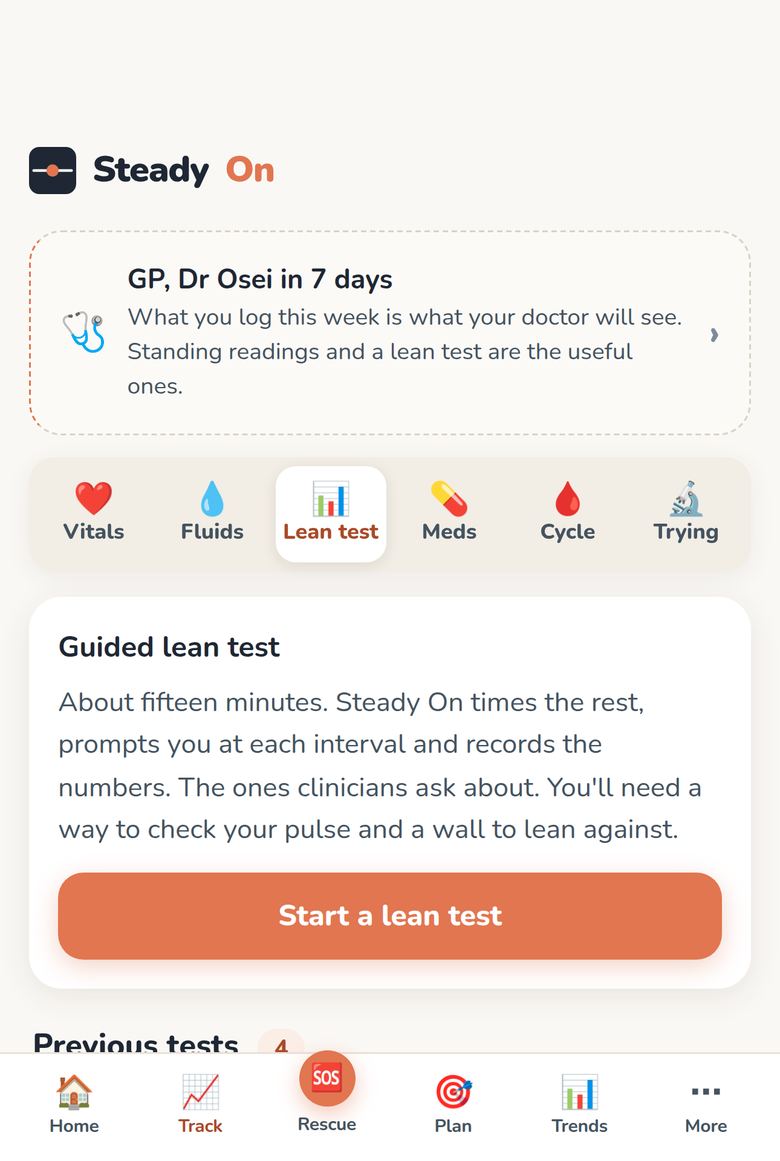
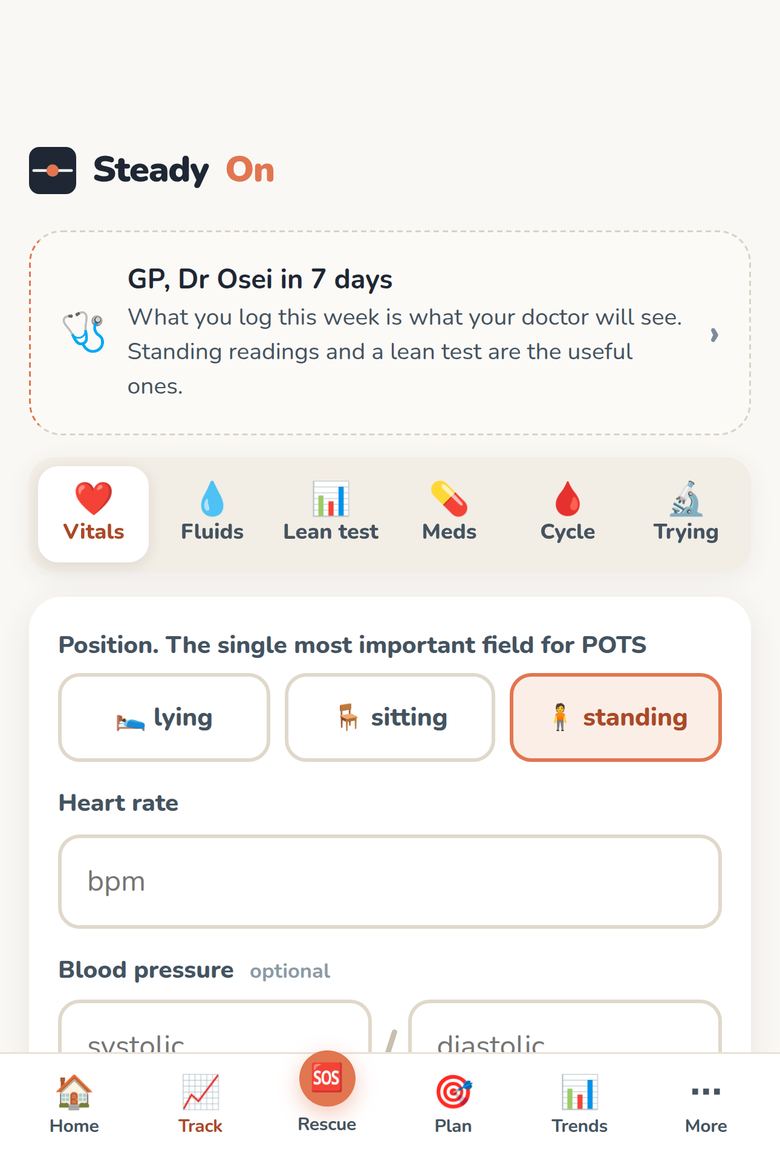
Heart rate by position, lying, sitting, standing, with time, tags and notes. A guided NASA Lean Test. Charts made for appointments.
Watch sync Coming soon
Apple Health and Health Connect (Samsung, Fitbit, Garmin) will capture your heart rate through the day, so your trends are not built only from the moments you felt bad enough to log. Coming to the Steady On app, Android first.
Proof it is working
A symptom burden score from your own logs, next to your standing heart rate and lean-test change, baselined on the month before you started. It reports a worse month as plainly as a better one.
Honest about gear
Community-tested compression, electrolytes and equipment, clearly labelled when links are affiliate, never pretending to be medical advice.
Everything in the app
What you get, and what you pay for.
No trial clock, no card to start. Here is the whole thing, honestly labelled, so you can see exactly where the line sits before you sign up for anything.
Free forever, no cardSteady On Plus
For the bad moments
The part you need when you are least able to go looking for it.
Free
The rescue page
Evidence-based counter-manoeuvres for a moment you feel faint: leg crossing, fist pumps, cooling, breathing. Works with no signal.
Free
Flare mode
One tap and the app stops asking things of you. Targets pause, your logging run is protected, and the tone changes until you turn it off.
Free
Add to your home screen
Installs like an app, opens like an app, and the rescue page keeps working offline.
Tracking, all of it free
Log as much as you like. Metering the thing you do to prove you are ill would be absurd, so we do not.
Free
Heart rate by position
Lying, sitting and standing, with the time, your own tags and a note. The distinction that makes the numbers mean something.
Free
Blood pressure
Systolic and diastolic alongside your heart rate, so the whole picture sits in one place.
Free
Guided lean test
The NASA Lean Test, timed and talked through, with your result and what the time of day means for it.
Free
Symptoms and severity
Dozens of tags including the ones nobody warns you about, with how bad it was and what you were doing.
Free
Fluids and salt
Running daily totals against a target, because the advice is useless without knowing where you actually are.
Free
Medication log
What you take, what it is for, when you started and stopped.
Free
Sleep and cycle
Two of the biggest hidden drivers of a bad week, recorded in the same place as everything else.
Free
Heat and weather
Temperature captured against your dates, without ever storing where you live.
Free
Your last 14 days
The dashboard, your latest readings and your logging run, free for good.
Learning, all of it free
Information about your own condition should not be behind a till.
Free
20 plain-English articles
What POTS is, the lesser-known symptoms, medication options, hydration and cortisol, why the time of day changes your test result.
Free
Week one of the 12-Week Reset
The full first week, including the safety screening, so you can see whether it suits you before paying anything.
Free
Movement library
Every exercise with an animated figure and a guided rep counter that tells you when to lift, hold and lower.
Plus
Guided cardio sessions
Warm-up, main block and cool-down, timed. It asks how hard it feels partway through and tells you to ease off, hold, or that you have room. Stopping early is a button, not a failure.
Free
Export or delete everything
Your whole record in one file whenever you want it, and one-tap account deletion.
What Plus adds
A heart rate on its own is a number. Steady On keeps what was happening around it: whether you were lying, sitting or standing, how warm the day was, where you were in your cycle, and what you were feeling at the time. Months of that is what turns a number into something worth showing a doctor.
Plus
Your whole history
Every reading you have ever taken, not just a fortnight.
Free
Your time-of-day pattern
Worked out on your own fortnight and shown in full, free. Most people find mornings hit hardest, and most people are tested in the afternoon.
Plus
15 more trend analyses
Triggers, heat, sleep, cycle, medication before and after, blood pressure, day of the week. Your patterns, found for you, across your whole history.
Plus
Are you improving?
A symptom burden score month against month, baselined on the month before you started, that reports a worse month as plainly as a better one.
Plus
Lean tests by time of day
Morning against afternoon against evening. This is where the answer usually hides.
Free
A one-test report for your doctor
Any guided lean test prints as a single sheet: the numbers, the time it was taken, and the published evidence on why that matters. Free, permanently.
Plus
The ninety-day doctor report
Every test compared, heart rate and blood pressure by position, symptom burden month against month, medication, fluids and salt, on one page to print or email. See a full example.
Plus
Weeks two to twelve
The rest of the programme: guided reps, rest days, read-ahead, and repeating a week whenever you need to.
Plus
Personal experiments
Does compression actually help you, or just other people? Run it properly and find out.
Plus
Early-warning signal
What your own data looked like in the days before your last bad stretch.
Plus
Pacing
Your energy envelope, your effort ceiling and your daily spoons, saved and tracked. A spoon is one thing that takes energy, so a shower is two.
Plus
Appointment pack
Plan the appointment, take the right questions, and record what was actually decided.
Plus
Work and study pack
Reasonable adjustments, and a letter to ask for them.
Plus
Has this been checked?
Twelve things commonly looked at alongside POTS, written as questions to ask rather than conditions you might have.
Plus
Carer sharing
A private read-only link for a parent, partner or carer. Expires when you say, revoked whenever you like.
Start free. Stay free if you want to.
The rescue page and the Learn library are free permanently, to everybody. No adverts on any tier, no selling your health data, and nothing is deleted if you stop paying.
You don't have to wait. Create a free account and you get week one of the 12-Week Reset
with its safety screening, heart rate by position, fluids, salt and symptoms, the guided
lean test, weather and cycle tracking, the rescue page and the whole Learn library.
No card, and no trial clock. Plus adds the rest of the programme, your full history and
the analysis.
We sell no advertising and take no sponsorship, on any tier. No selling your health data. No limit on how much you can log, because metering the thing you do to prove you are ill would be absurd.
What is included in the free tier and in Steady On Plus
Guided lean tests, and what the time of day means for your result
✓
✓
A one-test report for your doctor, printable, from any guided lean test
✓
✓
Your own time-of-day symptom pattern, worked out on your own data
✓
✓
Week one of the 12-Week Reset, safety screening included
✓
✓
How far back you can look
14 days
All of it
The ninety-day doctor report: every test, both positions, burden month against month, medication
·
✓
Lean tests split by morning, afternoon and evening, which is where the answer usually hides
·
✓
Weeks two to twelve of the 12-Week Reset, every session guided
·
✓
Are you improving: symptom burden month against month, and what is driving it
·
✓
The other 15 trend analyses: triggers, heat, sleep, cycle, medication, blood pressure
·
✓
Personal experiments: does compression actually help you?
·
✓
The early-warning signal, and pacing with your ceiling and spoons saved
·
✓
The appointment pack, the work and study pack, the comorbidity checklist
·
✓
Carer sharing, and health app sync when it arrives
·
✓
£30a yearor £3.50 a month
Cancel in one tap and keep it until the end of what you paid for. Or buy the
12-Week Reset once for £25 and keep it, if you would rather not subscribe.
No, and it will not try. It records your own numbers and shows you your own patterns. What it does do, which almost nothing else does, is tell you that orthostatic heart rate rise is largest in the morning: published research finds roughly 100% of people with POTS meet the diagnostic threshold on a morning test, around 44% in the afternoon and 28% in the evening, and about two thirds look normal on a single test taken at an arbitrary hour. If you were tested in the afternoon and told you were fine, that is worth knowing. Take it to a doctor. That is their job, not ours.
Is this medical advice?
No. Steady On is an educational programme and self-tracking toolkit built on published research. It doesn't diagnose, treat, or replace your medical team. We ask every member to confirm their doctor knows they're starting an exercise programme, and the app is designed to complement clinical care, not compete with it.
What if exercise has crashed me before?
You're exactly who this is designed for. Most exercise attempts fail for POTS bodies because they start upright and progress too fast. This programme starts lying down, progresses on your timeline, and treats repeating a week as a feature. The flare mode exists because pushing through is how people end up worse.
Do I need equipment?
No, nothing you must buy. The strength work needs a floor, a chair, a wall and a bottom stair. For the cardio the app gives you five options, cheapest first: lying leg cycling and seated marching cost nothing, a resistance band is about £5, and a mini pedal exerciser is about £25 and is the one worth having. A recumbent bike, rower or pool is better if you can get it and is not required. A heart-rate monitor, any basic sports watch, genuinely helps. The Gear Zone in the app lists budget options with prices, and says plainly which links earn us anything and which do not.
What does it cost?
Free, permanently: the rescue page, the whole Learn library, logging your heart rate, blood pressure, symptoms, fluids, salt, medication and cycle, guided lean tests with the time-of-day guidance and a printable one-test report for your doctor, your last 14 days of data, your own time-of-day symptom pattern worked out on it, and week one of the 12-Week Reset. No card, and no trial clock counting down while you are having a bad fortnight.
Plus adds the rest. Your whole history, the other fifteen trend analyses, the
improvement analysis, the ninety-day doctor report, weeks two to twelve of the 12-Week Reset,
pacing, the appointment and work packs, the comorbidity checklist and carer sharing.
Cancel in one tap and you keep it until the end of what you paid for.
Steady On is built independently, with its content grounded in the published Levine and CHOP research protocols and in peer-reviewed studies of what people with POTS actually say they need. Independent clinical review is the next thing on the list, and until it has happened we say so rather than implying otherwise.
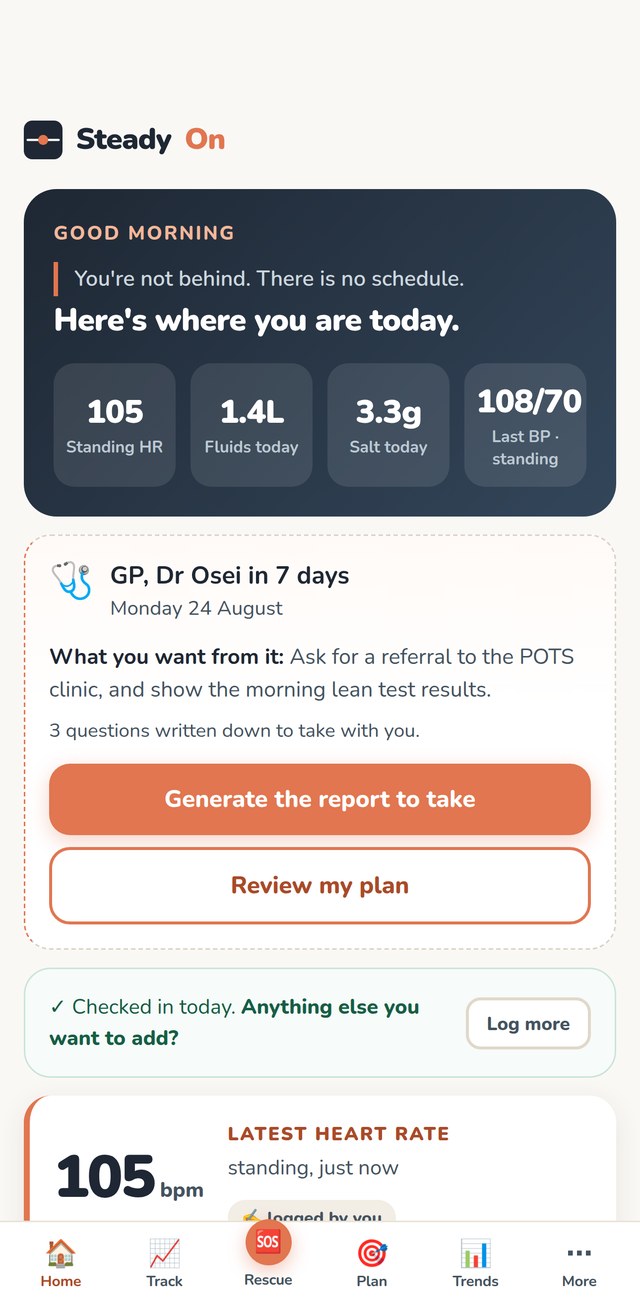 Your day at a glance
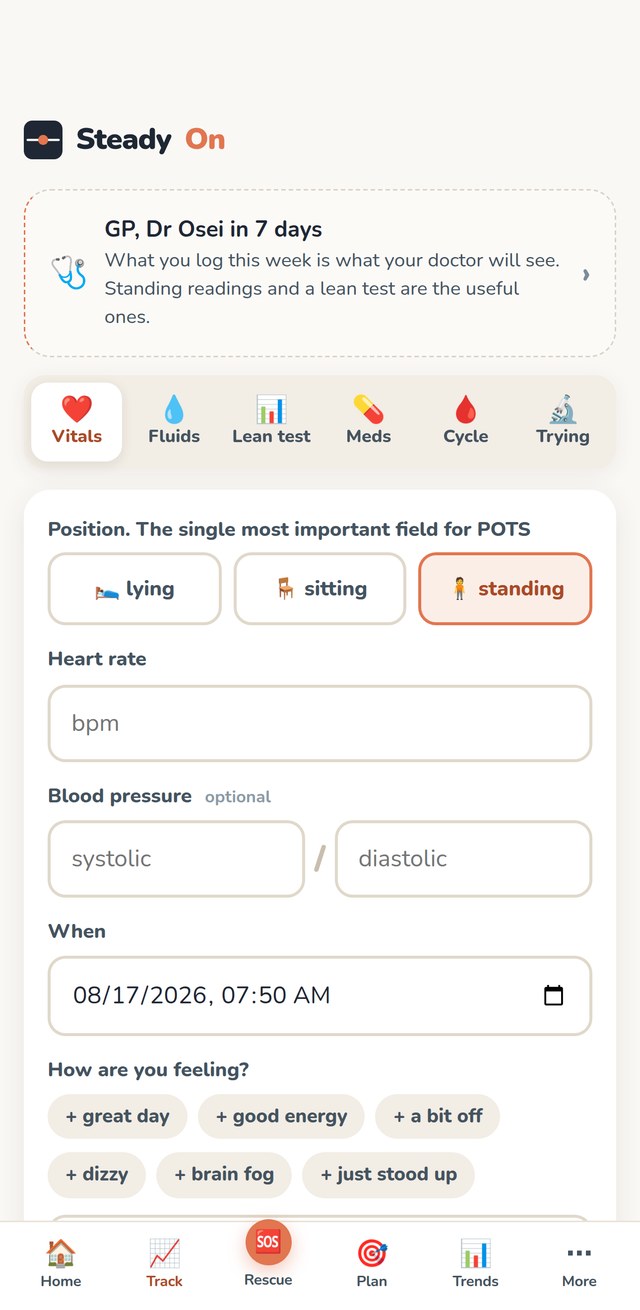 Log it in seconds
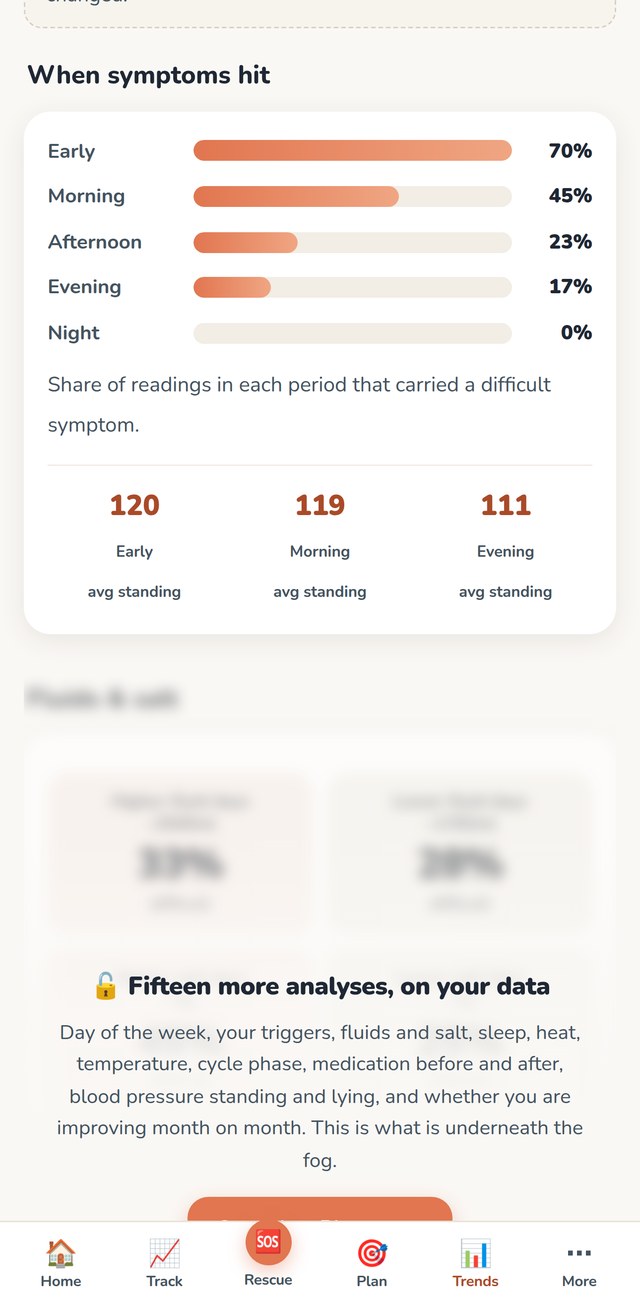 See your own patterns
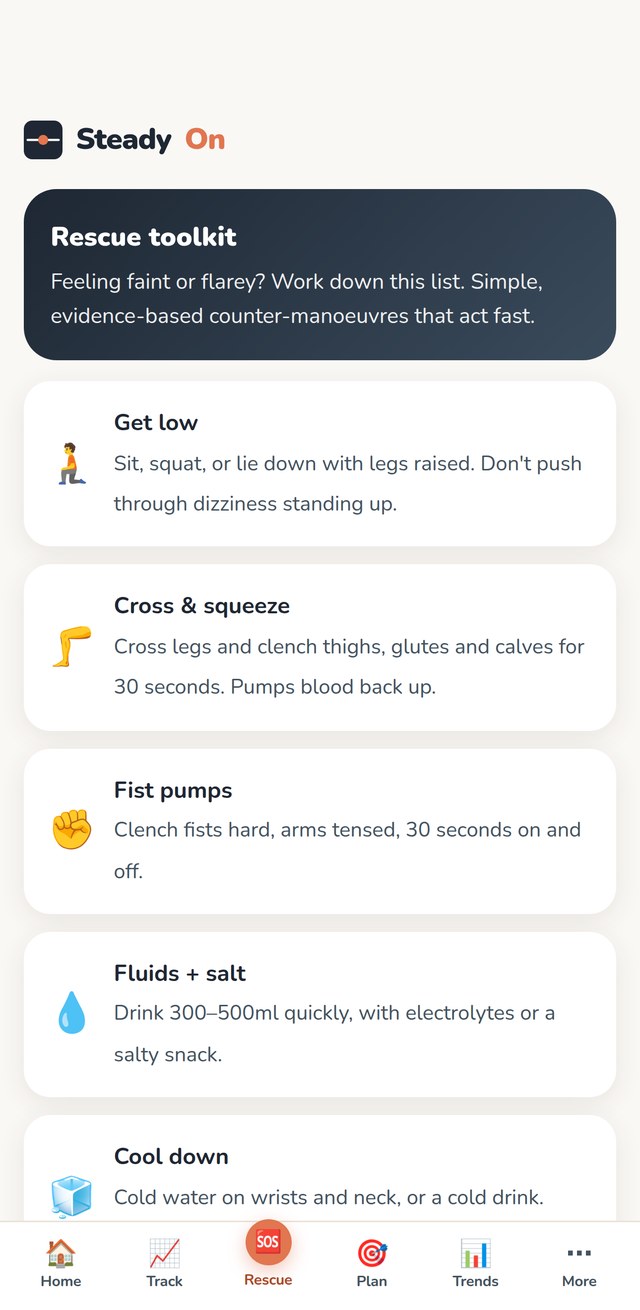 For the bad moments